> For the complete documentation index, see [llms.txt](https://docs.tabnine.com/main/llms.txt). Markdown versions of documentation pages are available by appending `.md` to page URLs; this page is available as [Markdown](https://docs.tabnine.com/main/getting-started/tabnine-chat/consume.md).
# Reviewing suggestions
Tabnine AI code assistant: Reviewing suggestions
## How to review the Tabnine Chat suggestions
Once you get an answer from Tabnine Chat, review it. If you aren't satisfied with the answer, refine your original request with an alternative or a more specific prompt **in the current or new session**.
If you're happy with the response, you can add it to your code in one of the following ways.
### Manual Copy and Paste
Copy the answer (or part of it) and paste it into the relevant location in your code:
### Copy Function
Click **Copy,** then paste the answer into the relevant location in your code:
### Insert Action
Click **Insert** to copy and insert the code into the open file with one click.
The code is pasted at the cursor location or inside the selected block:
### Show Diff
If the Chat answer is close enough to the current open file, a **Show diff** option appears. Click **Show diff** to see the specific change offered by Tabnine.
To paste the changes into the file, click **Insert**.
{% hint style="info" %}
Diff insert is available in VS Code, JetBrains and Visual Studio 2022
{% endhint %}
In VS Code, you'll need to **Accept** each change inline:
Show diff, Insert, and Accept in VS Code
### Apply
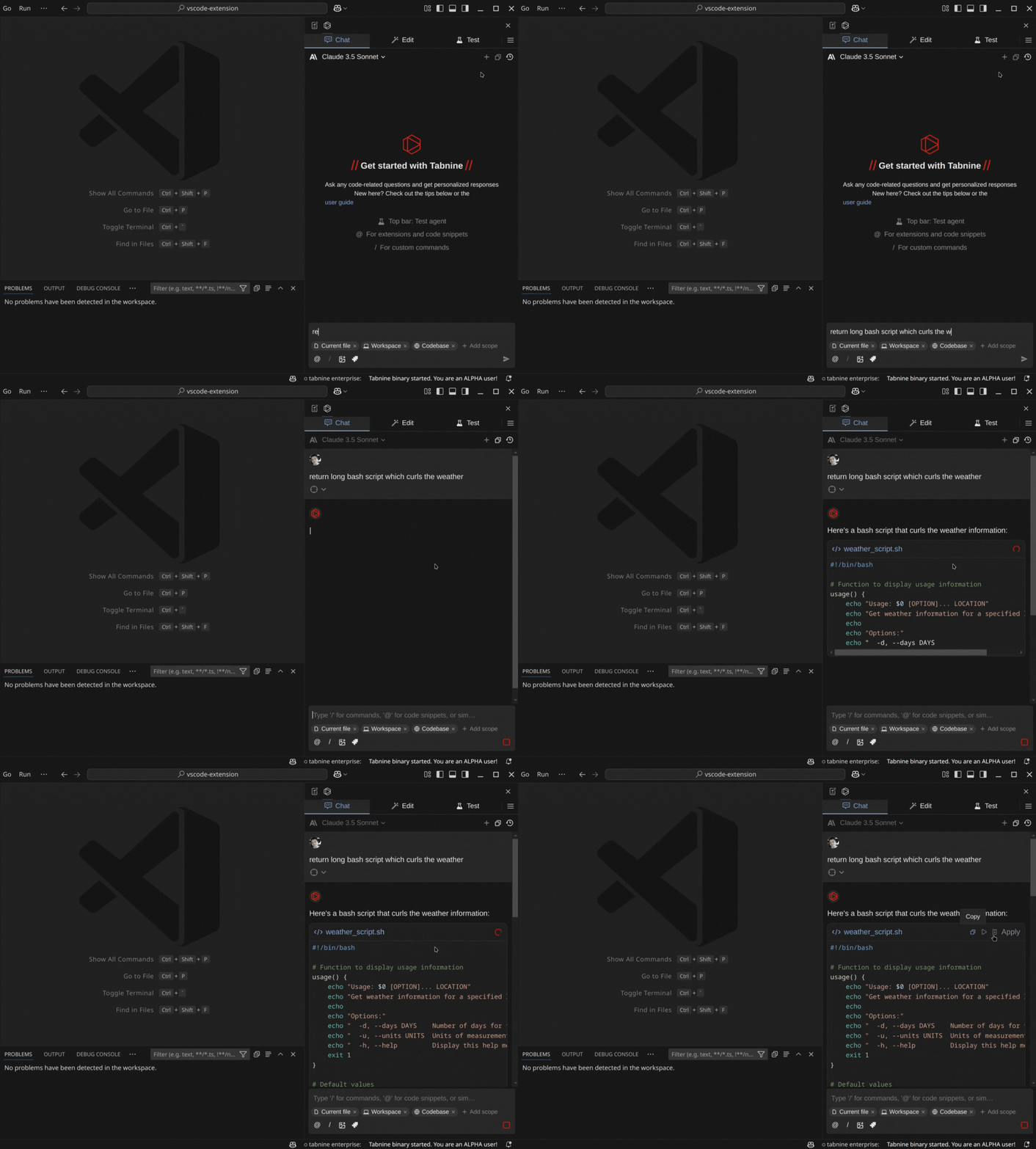
Within Chat, you will have the option to apply suggestions directly to the relevant code snippet in your target file.
After generating a response, the Apply button will appear in the upper right-hand corner of the code snippet. Simply click and the code will be inserted.
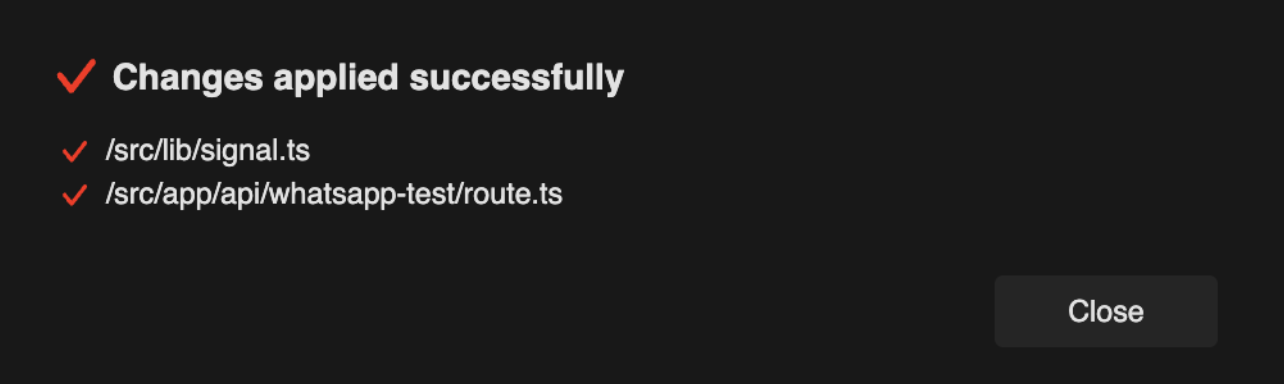
You should receive confirmation of changes with a screen that lists the files where code changes were applied, similar to this:
Changes applied successfully using the 'Apply' button in Tabnine
#### References
If the context for local code awareness is enabled, by default the Tabnine Chat tries to answer the user questions with context from the local workspace. When returning the answer to the user, Tabnine Chat is explicit about the context used to answer the question by including a list of references:
You can click each reference and get to the full code that was induced in the chat context. \\
---
# Agent Instructions
This documentation is published with GitBook. GitBook is the documentation platform designed so that both humans and AI agents can read, navigate, and reason over technical content effectively. Learn more at gitbook.com.
## Querying This Documentation
If you need additional information that is not directly available in this page, you can query the documentation by asking a question.
Perform an HTTP GET request on the following URL with the `ask` and `goal` query parameters:
```
GET https://docs.tabnine.com/main/getting-started/tabnine-chat/consume.md?ask=&goal=
```
`ask` is the immediate question: it should be specific, self-contained, and written in natural language.
`goal` is what the user is ultimately trying to achieve, the reason they need the answer. Sharing it helps GitBook give you a better, more relevant answer. A goal is most helpful when it describes the outcome the user wants rather than restating the question. For example, with `ask=how do I create an API token`, a goal like `automate deployments from our CI pipeline` lets GitBook tailor the answer to that use case.
The response will contain a direct answer to the question and relevant excerpts and sources from the documentation.
Use this mechanism when the answer is not explicitly present in the current page, you need clarification or additional context, or you want to retrieve related documentation sections.